In the competitive landscape of American sports—from the high-tech surfaces of SoFi Stadium to the sprawling collegiate complexes of the SEC—the playing field is no longer just a patch of grass. It is a highly engineered biomechanical system. For students in the United States pursuing degrees in Sports Engineering, Agronomy, or Kinesiology, mastering the physics of these surfaces is essential for player safety and field longevity.
The modern “turf scientist” must navigate the complex intersection of material science and mechanical engineering. This involves calculating precise variables like the Coefficient of Restitution (how a ball bounces) and Vertical Deformation (how the surface shifts under an athlete’s weight). In the NFL, for instance, surfaces are scrutinized under the “Cleat-Surface Interaction” model to minimize non-contact ACL injuries, a major area of study in US sports medicine.
Mastering the Hydraulic Gradient: A Challenge for Students
A primary technical hurdle in sports engineering is the management of subsurface water flow. This is governed by Darcy’s Law, which calculates the hydraulic gradient to ensure that a heavy downpour in Florida or a snowmelt in Green Bay doesn’t compromise the field’s structural integrity.
Q = -KA \frac{dh}{dl}
Calculating the exact “K” factor (hydraulic conductivity) requires a sophisticated understanding of differential equations and soil porosity. Because these variables are so high-stakes—often determining the safety of multi-million dollar athletes—the technical reporting required in American universities is exceptionally rigorous. Many undergraduates find that mastering the documentation of these fluid dynamics models is a significant hurdle, often requiring specialized assignment writing help to ensure their technical analyses align with the precise formatting and data integrity expected by US engineering faculties.
See also: Blockchain and the Digital Economy
G-Max Testing and US Safety Standards
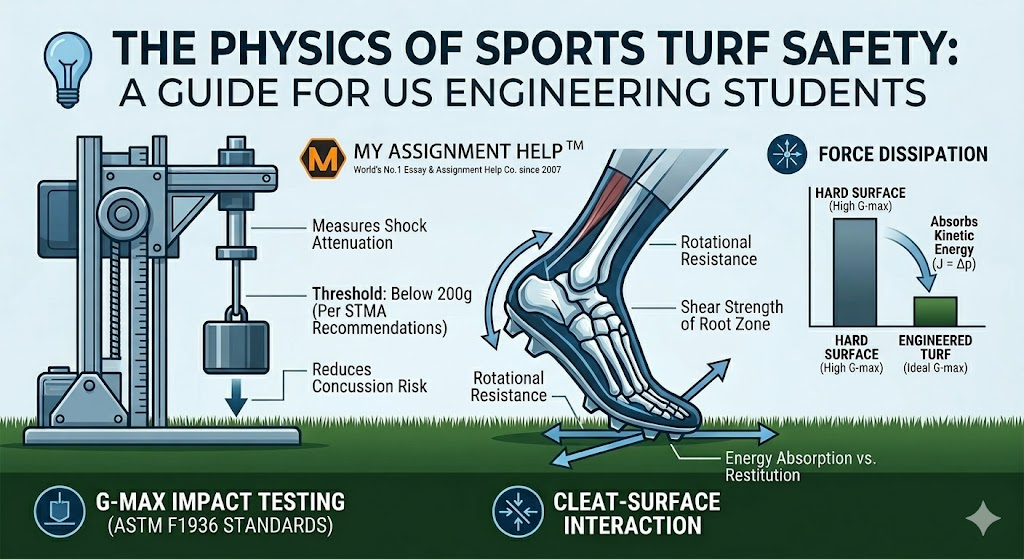
In the United States, the gold standard for surface safety is the G-max test, regulated by ASTM F1936. This measures the shock-attenuation of the field. A “cleat-head” or “missile” is dropped from a specific height, and an accelerometer measures the peak deceleration.
- The Threshold: According to the Sports Turf Managers Association (STMA), a G-max value exceeding 200g is considered hazardous, as the surface becomes too “hard” to safely absorb the kinetic energy of a falling player.
- The Biomechanics: For a student analyzing this, you must calculate the impulse ($J = \Delta p$) to determine how much force is being transferred back into the athlete’s skeletal system. Given the complexity of modeling these impact forces across different infill materials, students often seek targeted physics homework help to solve the multi-variable calculus problems associated with shock-wave dissipation.
Data-Driven Comparison: US Sports Surface Metrics
| Metric | Natural Grass (US GA-5 Bermudagrass) | Synthetic “Cool-Play” System |
| G-Max Range | 80g – 110g (Ideal) | 120g – 165g (Standard) |
| Peak Surface Temp | 85°F – 95°F | 140°F – 160°F |
| Infiltration Rate | 10+ inches per hour | 20+ inches per hour |
| Primary Physics Focus | Shear Strength & Root Density | Particle Shape & Infill Displacement |
Thermodynamics and the Albedo Effect in US Stadiums
One of the most pressing issues for US turf managers in sun-belt states is the “Urban Heat Island” effect. Synthetic turf can reach temperatures upwards of 160°F, which is nearly double the ambient temperature of 80°F on a typical game day.
To combat this, engineers utilize the Albedo Effect—the measure of diffuse reflection of solar radiation. By incorporating “cool-fill” materials (like treated cork or coated sand), they can lower the surface temperature by nearly 30°F, ensuring the safety of players and preventing heat-related illnesses during late-summer training camps.
Key Takeaways
- Regulatory Compliance: Following STMA and ASTM F1936 standards is mandatory for all professional and high-level collegiate fields in the US.
- Impact Modeling: G-max values are the primary indicator of concussion risk associated with surface hardness.
- Drainage Physics: Darcy’s Law is essential for calculating the hydraulic conductivity needed to prevent surface ponding.
- Thermal Management: Thermodynamic cooling is a critical design factor for fields in the southern United States.
Frequently Asked Questions (FAQs)
1. What is the maximum safe G-max for a high school football field in the USA?
The industry standard set by ASTM is 200g, though many US organizations, including the STMA, recommend maintaining fields closer to 100g-120g for optimal safety.
2. How does the “cleat-surface interaction” impact physics?
It focuses on rotational resistance. If the “torque” required to release the cleat is too high, the energy is transferred to the player’s knee or ankle, causing injury.
3. Why do US stadiums prefer sand-based root zones?
Sand-based systems provide superior drainage (hydraulic conductivity) and resist compaction better than native soil, keeping the G-max levels consistent over time.
4. How hot can synthetic turf get in the summer sun?
In regions like Texas or Arizona, untreated synthetic turf can easily exceed 150°F, requiring irrigation even on “dry” days specifically for thermal cooling.
Author Bio
Dr. Jonathan Miller is a Senior Academic Content Strategist at MyAssignmentHelp. With a PhD in Applied Mechanics and a background in US environmental engineering, Dr. Miller specializes in helping students navigate the technical rigors of STEM-based athletic research and sports surface technology.
References
- STMA (Sports Turf Managers Association). (2026). Field Safety & Maintenance Standards.
- ASTM International. (2026). F1936-26: Standard Specification for Impact Attenuation of Turf Systems.
- National Football League (NFL) Field Testing Protocols, 2026 Update.